By: Olivier BAKOMEZI,
Director of the Refugees Parliamentarians for Peace-RPP
and Chairman of the Congolese Urban Refugee Community.
Date: April 20th, 2026.
Abstract
Uganda hosts one of the largest refugee populations in Africa and is internationally recognized for its progressive refugee policies. Despite these efforts, refugees continue to face major challenges in accessing quality education. This article examines the institutional, economic, and sociocultural barriers affecting access to quality education among refugees in Uganda. Using a qualitative and analytical approach based on secondary literature, policy reports, and empirical studies, the paper explores how overcrowded schools, inadequate infrastructure, teacher shortages, poverty, language barriers, gender inequalities, and social exclusion limit educational opportunities for refugee children and youth. The study further evaluates the effectiveness of Uganda’s inclusive education policies and highlights the gap between policy intentions and implementation realities. The article concludes by proposing policy recommendations aimed at improving educational inclusion, quality, and sustainability within refugee-hosting communities.
Keywords: Refugees, quality education, Uganda, educational access, inclusive education, barriers, refugee policy.
1. Introduction
Education is recognized globally as a fundamental human right and a critical instrument for social transformation, economic development, and peacebuilding. Sustainable Development Goal 4 (SDG 4) emphasizes the importance of ensuring inclusive and equitable quality education for all. However, refugees remain among the most vulnerable populations in accessing educational opportunities, particularly in developing countries hosting large refugee populations.
Uganda has emerged as one of Africa’s leading refugee-hosting countries due to its open-door refugee policy and progressive legal framework. According to the United Nations High Commissioner for Refugees (UNHCR), Uganda hosts refugees primarily from South Sudan, the Democratic Republic of Congo, Burundi, Somalia, and other neighboring countries. Refugees are accommodated in settlements such as Bidi Bidi, Nakivale, and Kyangwali, Kampala among others.
Although Uganda’s refugee policy grants refugees the right to education and integration into national systems, access to quality education remains highly constrained. Refugee learners encounter institutional limitations such as overcrowded classrooms, insufficient teachers, and inadequate learning materials. Economic hardships, including poverty and the inability to afford indirect school costs, further undermine educational participation. In addition, sociocultural barriers such as language difficulties, discrimination, gender inequality, and trauma continue to affect educational outcomes.
This article investigates the major barriers to quality education among refugees in Uganda by focusing on institutional, economic, and sociocultural dimensions. It aims to contribute to existing scholarship on refugee education and provide policy-oriented recommendations for improving educational access and quality.
2. Research Objectives
2.1 General Objective
To examine the challenges affecting refugees’ access to quality education in Uganda.
2.2 Specific Objectives
- To analyze institutional barriers affecting refugee education in Uganda.
- To assess the economic challenges limiting access to quality education among refugees.
- To examine sociocultural factors influencing refugee educational participation.
- To propose policy recommendations for improving access to quality education for refugees.
3. Research Questions
- What institutional barriers affect access to quality education among refugees in Uganda?
- How do economic factors influence refugee participation in education?
- What sociocultural challenges hinder refugees from accessing quality education?
- What strategies can improve refugee educational inclusion and quality in Uganda?
4. Literature Review
4.1 Concept of Quality Education
Quality education extends beyond school enrollment and includes effective teaching, adequate learning materials, safe learning environments, qualified teachers, learner participation, and positive educational outcomes. UNESCO defines quality education as education that promotes cognitive development while fostering social, emotional, and ethical growth.
For refugee populations, quality education also includes psychosocial support, inclusive learning environments, language support, and protection from discrimination. Refugee education must therefore address both academic and humanitarian needs.
4.2 Refugee Education in Uganda
Uganda’s Refugee Act of 2006 and Refugee Regulations of 2010 provide refugees with rights to education, movement, employment, and access to social services. Refugee children are integrated into Uganda’s national education system rather than isolated in separate schools.
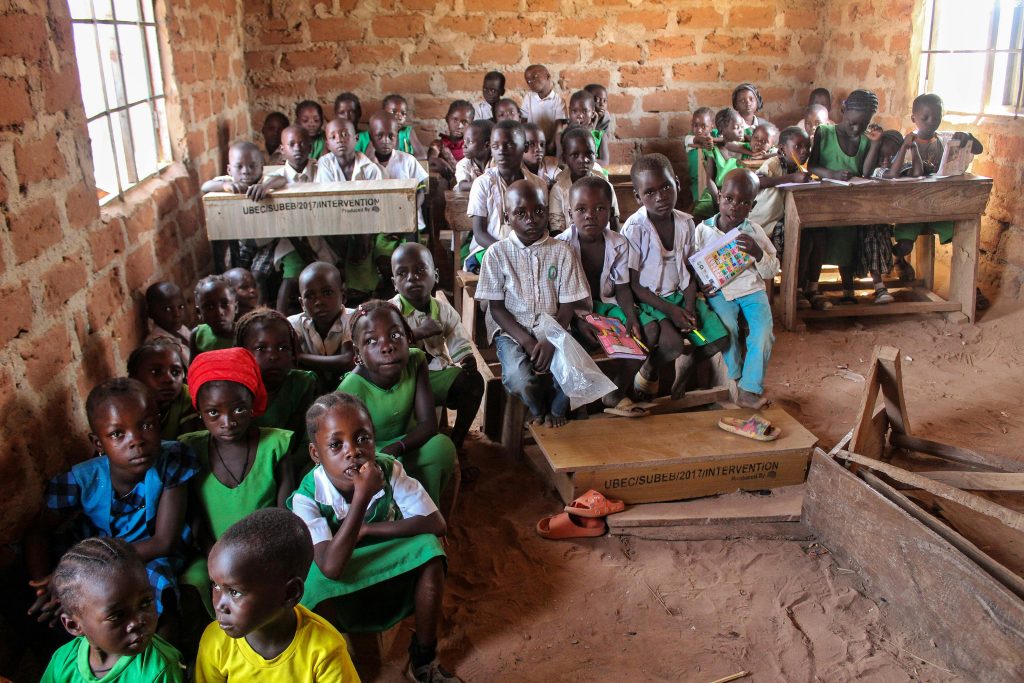
Despite these progressive policies, studies indicate that refugee-hosting districts face severe pressure on educational infrastructure and public services. Schools in refugee settlements often experience overcrowding, inadequate sanitation facilities, and shortages of instructional materials.
4.3 Institutional Barriers
Institutional barriers refer to systemic and administrative limitations affecting educational delivery. Several studies identify teacher shortages as a major challenge in refugee-hosting areas. In many refugee settlements, one teacher may serve more than one hundred learners, making individualized learning difficult.
Inadequate infrastructure is another significant problem. Many schools lack sufficient classrooms, libraries, laboratories, desks, and sanitation facilities. Long distances between refugee settlements and schools also discourage attendance, especially for younger children and girls.
Furthermore, inconsistent funding from humanitarian organizations and limited government resources negatively affect educational sustainability.
4.4 Economic Barriers
Although primary education in Uganda is officially free under Universal Primary Education (UPE), refugee families continue to face indirect educational costs such as uniforms, transportation, examination fees, books, and meals(school requirements)
Refugee households often experience extreme poverty and unstable livelihoods. Many children are forced to engage in income-generating activities or domestic work to support their families. Consequently, school attendance and retention rates remain low among refugee populations.
Economic vulnerability particularly affects girls, who are more likely to drop out of school due to early marriage, domestic responsibilities, and financial pressures.
4.5 Sociocultural Barriers
Language barriers significantly affect refugee learners in Uganda. Many refugees come from French-speaking or Arabic-speaking backgrounds and struggle to adapt to English-medium instruction.
Discrimination and social exclusion also undermine educational participation. Refugee learners may face stigmatization from host communities or peers, leading to low self-esteem and reduced academic engagement.
Gender inequality remains another critical challenge. Cultural norms in some refugee communities prioritize boys’ education over girls’ education, limiting female educational participation.
In addition, many refugee children have experienced conflict, displacement, violence, and trauma. Without adequate psychosocial support, these experiences negatively affect concentration, learning capacity, and school performance.
5. Theoretical Framework
This study is guided by the Human Rights-Based Approach to Education and the Theory of Social Inclusion.
The Human Rights-Based Approach argues that education is a universal right that must be accessible, available, acceptable, and adaptable to all individuals regardless of their status.
The Theory of Social Inclusion emphasizes the importance of eliminating barriers that prevent marginalized populations from participating fully in society. In the context of refugee education, social inclusion requires equitable educational opportunities and supportive learning environments.
These theories provide a useful framework for understanding the educational inequalities experienced by refugees in Uganda.
6. Methodology
6.1 Research Design
This article adopts a qualitative descriptive research design based on secondary data analysis.
6.2 Sources of Data
The study relies on:
- Academic journal articles
- UNHCR reports
- UNESCO publications
- Government policy documents
- NGO reports on refugee education
6.3 Data Analysis
Data were analyzed thematically by categorizing findings into institutional, economic, and sociocultural barriers.
7. Findings and Discussion
7.1 Institutional Challenges
The findings indicate that institutional limitations remain major obstacles to quality refugee education in Uganda. Schools located in refugee-hosting areas are severely overcrowded due to increasing refugee populations and limited educational infrastructure.
Large class sizes reduce teacher effectiveness and limit learner participation. Teachers often experience excessive workloads and insufficient professional training related to refugee education and psychosocial support.
Inadequate educational infrastructure further undermines learning conditions. Many schools lack enough classrooms, furniture, libraries, and sanitation facilities. In some settlements, learners’ study under temporary shelters or trees.
Moreover, limited coordination between government institutions and humanitarian organizations affects educational planning and resource allocation.
7.2 Economic Challenges
Economic hardship emerged as a central factor affecting refugee educational participation. Refugee families frequently struggle to meet basic needs such as food, shelter, and healthcare, making education a secondary priority.
Although tuition may be free, indirect school costs discourage attendance. Many refugee children lack uniforms, scholastic materials, and transportation.
Poverty also contributes to child labor and school dropout. Some refugee children engage in small-scale trading, agriculture, or domestic work to support household survival.
Economic inequalities between refugee and host communities may further generate competition over limited educational resources.
7.3 Sociocultural Challenges
Language difficulties continue to affect refugee learners’ academic integration. Learners from non-English-speaking backgrounds often struggle to follow classroom instruction and communicate effectively.
Gender disparities remain evident in refugee education. Girls face higher risks of school dropout due to early marriage, menstruation-related challenges, domestic responsibilities, and insecurity during travel to school.
Discrimination and stigma also negatively affect refugee learners. Some refugee students experience exclusion or bullying from peers, which reduces confidence and motivation.
Additionally, trauma resulting from war, displacement, and family separation affects learners’ mental health and academic performance.
8. Policy Implications and Recommendations
To improve refugee access to quality education in Uganda, several policy interventions are necessary.
8.1 Strengthening Educational Infrastructure
The government and development partners should invest in additional classrooms, libraries, sanitation facilities, and teacher housing in refugee-hosting districts.
8.2 Increasing Teacher Recruitment and Training
More qualified teachers should be recruited to reduce overcrowding and improve educational quality. Teachers should also receive specialized training in inclusive education, trauma-informed teaching, and multilingual instruction.
8.3 Expanding Financial Support
Scholarships, school feeding programs, and the provision of learning materials should be expanded to reduce economic barriers for refugee learners.
8.4 Promoting Gender Equality
Targeted interventions should support girls’ education through menstrual hygiene programs, protection initiatives, and community sensitization against early marriage.
8.5 Enhancing Psychosocial Support
Schools should integrate counseling services and psychosocial support programs to address trauma and improve student well-being.
8.6 Strengthening Policy Implementation
The Ugandan government and humanitarian agencies should improve coordination mechanisms to ensure effective implementation of refugee education policies.
9. Conclusion
Uganda has demonstrated strong political commitment toward refugee protection and educational inclusion. Nevertheless, refugees continue to face substantial institutional, economic, and sociocultural barriers that limit access to quality education.
Overcrowded classrooms, inadequate infrastructure, teacher shortages, poverty, language difficulties, gender inequalities, discrimination, and trauma collectively undermine refugee educational outcomes.
Addressing these challenges requires collaborative efforts from government institutions, international organizations, civil society, and refugee communities themselves. Sustainable investment in educational infrastructure, teacher development, financial assistance, and psychosocial support is essential for ensuring inclusive and quality education for refugees in Uganda.
Improving refugee education is not only a humanitarian obligation but also a strategic investment in peacebuilding, social cohesion, and sustainable development.
References
Dryden-Peterson, S. (2016). Refugee education: The crossroads of globalization. Educational Researcher, 45(9), 473–482.
Kirk, J., & Winthrop, R. (2007). Promoting quality education in refugee contexts: Supporting teacher development in Northern Ethiopia. International Review of Education, 53(5–6), 715–723.
United Nations High Commissioner for Refugees (UNHCR). (2024). Global Trends Report.
UNESCO. (2021). Refugee Education in Crisis Contexts.
Republic of Uganda. (2006). The Refugees Act.
Republic of Uganda. (2010). Refugee Regulations.
Mendenhall, M., Gomez, S., & Varni, E. (2018). Teaching amidst conflict and displacement: Persistent challenges and promising practices for refugee, internally displaced and national teachers. NORRAG.
World Bank. (2023). Uganda Education and Refugee Inclusion Report.
Dryden-Peterson, S., Adelman, E., Bellino, M., & Chopra, V. (2019). The purposes of refugee education: Policy and practice of including refugees in national education systems. Sociology of Education, 92(4), 346–366.
United Nations Children’s Fund (UNICEF). (2022). Education for Refugee and Host Community Children in Uganda.